Settler colonialism and frontier violence
The Drover's WifeSettler colonialism and frontier violence are the linked forces that reorder the novel’s high-country world: settlers claim land and its commercial promise while Indigenous people are driven from Country, subjected to racialized violence, and denied authority over their own lives. The narrative traces this process from an encounter built on incompatible understandings of land to the development of Everton, then follows its consequences into policing, family separation, and the struggle to sustain community and cultural knowledge.
Land, encounter, and incompatible understandings
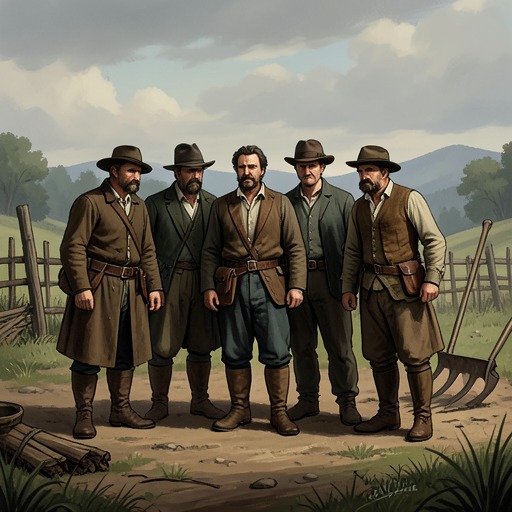
When Charles Edwards and his party arrive in the high country in the early 1820s, they initially befriend local Ngarigo people. The Ngarigo elder King Jimmy shows the newcomers tracks that are difficult for outsiders to see, offering knowledge grounded in long-standing relationships with the land. The settlers, in turn, regard the country as promising pasture for sheep. The meeting therefore involves more than two groups looking at the same landscape: each brings a distinct account of what the land is and what their presence there means.
The Ngarigo understand the high country through ancient connections, songlines, seasonal life, and the resources that have sustained their people. The settlers see grazing grounds and commercial opportunity. Their shared nods of appreciation conceal this divergence: each group believes the other is agreeing with its own understanding. The novel makes that misunderstanding an origin point for the destruction that follows, stressing that the damage will not be confined to plant life. The failure to recognize Ngarigo relationships to Country allows settler occupation to be mistaken for a mutually understood use of land.
From pastoral wealth to dispossession
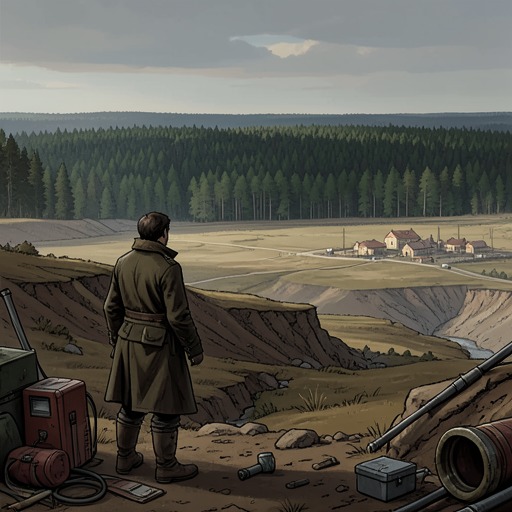
The account of frontier expansion is tied to material interests rather than presented as violence detached from everyday economic life. Sheep, droving, and sales connect the high country to markets and settler wealth. The Edwards family’s early search for grazing land becomes part of a longer process of settlement; Charles later argues at district meetings for developing the outpost of Cresthill, pointing to the stock route and the arrival of more farmers and settlers. He offers to help finance the town, while describing the need to manage the Indigenous population.
As the novel’s 1890s setting approaches, the wool economy is in crisis. The depression has severely affected the sheep industry, leaving households and businesses under pressure. The Edwards enterprise, which sells local wool in Melbourne to overseas markets and supports farmers and drovers, is also losing traction. These commercial pressures do not erase the earlier dispossession; instead, the story sets the precarious settler economy beside the deeper conflict over who may occupy and govern the land. Everton’s development is both a local response to the stock trade and a continuation of a settlement project first advanced through the proposed removal of Ngarigo people.
The town’s changing name reflects whose preferences prevail in that project. It was first intended to bear the name Evelyn, after the Edwards matriarch, but the all-male council favors Everton as a more masculine choice. Development eventually proceeds alongside existing facilities and new construction, including the saleyards planned as a focal point for the district’s large sheep sales. The town’s infrastructure gives commercial settlement a durable form, while the story’s account of its origins keeps visible the coercive policies that made expansion possible.
Gendered violence and the frontier’s aftermath
The novel shows that frontier violence falls especially heavily on Ngarigo women. During the early encounter, white men assault women, using weapons and threats to prevent resistance. The violence produces consequences beyond the immediate harm: a Ngarigo woman reports what happened to her husband, and her account helps prompt a council in which the men decide to confront the settlers and demand punishment. By then the white party has already left. The absence of accountability is part of the frontier’s structure: settlers can inflict harm and depart, while the people left to respond must do so without access to an authority that will recognize their claims.
This history also reaches into later generations. Charles has a child with a young Aboriginal woman after taking her by force; the child is Waraganj, later known in the district as Black Mary. Her mixed ancestry places her at the intersection of family history and racialized judgment, while her life demonstrates how colonial violence persists beyond the moment in which it is committed. The account of her departure from her clan and her mother’s death further connects personal loss to the weakening of family and community ties under conditions shaped by settler power.
Dispersal, policing, and racial classification
As settlers arrive in increasing numbers, fences divide the land and Indigenous people are forced away from their homelands. The novel describes a transformation in everyday life: communities that once moved with the seasons are made to hide and to concentrate on survival. It presents the policy of shooting Indigenous people on sight, or dispersing them, as an asserted colonial right, and connects that policy to meetings where settlers discuss the removal of local people as a precondition for town development. A consensus is reached and implemented quickly, giving organized force the backing of an emerging civic order.
In the later plot, the same logic is expressed through policing and the language of criminality. Yadaka, a wanted Aboriginal man, understands his offense in starkly unequal terms: his own explanation is that he is being punished for existing while black. His history includes imprisonment, forced separation from his homeland, and repeated attempts to return north to his people. Although the Matthews household taught him to read and write and gave him a place to live, he continues to long for his mother’s country and clan. His movement through the mountains is therefore not simply flight from an individual authority; it is also a search for belonging under a regime that constrains Indigenous movement and treats Aboriginal presence as a threat.
The policing of Molly Johnson shows how racialized suspicion and gendered vulnerability reinforce each other. Nate Clintoff is told that Molly will be checked on, but that the responsible party may take two days to reach her and will then consider its responsibility to her welfare over. The administrative delay leaves her exposed in the meantime. Her poverty, isolation, and need to protect her children do not secure meaningful protection; instead, the surrounding system treats a white woman’s safety as secondary to the pursuit of a wanted Aboriginal man.
Children, community, and cultural continuity
The threat of removal brings colonial classification into the home. Miss Shirley labels Molly’s children as of mixed descent and urges Judge Eisenmangher to authorize their removal in the name of their safety. The judge signs the order. The episode reveals the gap between the language of protection and the coercive consequence it permits: an outside authority claims power over the children while disregarding the family and community relationships through which they are cared for. Racial categorization becomes an instrument of state intervention, not a neutral description.
Against this threat, the novel sets forms of kinship and care that exceed the colonial household. Yadaka tells Molly that Ginny May is her family and her children’s family, then gives her directions to his winter cave, a two-and-a-half-day walk to the north-east. He describes a route by the Great Waterhole, a circular clearing, and three boulders, and offers the prospect of shelter, food, and eventual reunion with her people. The invitation makes survival inseparable from Country and community: a place to endure the winter is also a path toward belonging.
The ending extends that possibility into the next generation. Danny and his brothers carry forward a men’s-business ceremony learned in the high country from their Ngarigo family, and they take pride in maintaining cultural knowledge as modern pressures threaten it. Their participation does not undo dispossession or restore what has been lost, but it establishes continuity where colonial authority has tried to break it. The novel thus presents frontier violence not as a closed episode in the past but as a force whose effects persist in law, land use, family life, and memory—and whose attempted erasure is answered by the ongoing transmission of culture.